Saturday, September 26, 2009
A Contest! Let's Have A Contest!
Friday, September 25, 2009
Awards

Interview: Ripley Patton
1) What made you go for short stories and how long have you been writing seriously? Did you ever consider writing novels?
Ever since I could write, I have. For me writing is a necessary process in making sense of the world and my own inner landscape. I write to find meaning and, where none can be found, to create it. However, I started pursuing writing as a serious career in 2005. Stories came to me, and I wrote them down in as many words as it took to tell them. I had no real designs as far as length. If they were short, it was because they wanted to be. That being said, I have always loved short forms of both poetry and prose. There is something about capturing the precise and poignant moment; about creating the most lasting impression in the fewest words that I find wholly gratifying. I do periodically try to manifest a novel, mostly after having been asked again when I am going to write a novel. Conversely, I don't know that I have ever heard a novelist asked when they are going to start writing short stories. To date, all my attempts at novel writing have resulted in more short stories. I think if I wanted to force the issue, I could, but I doubt I'd be proud of the results
2) How do you go about finding markets for your stories? Do you start with one in mind, or look once the story is finished? If both, which do you think is the more successful method?
I write the stories that come to me, the things that inspire and interest me and clamor in my head to be told. There is a quote attributed to the Aborigines of Australia that says, "The big stories are always hunting the right person to tell them." I believe that and I tend to think of stories as gifts, rather than commodities. I always write and fall in love with my stories first. The marketing comes afterwards, and it is a matter of finding the right home for each beloved story, rather than trying to fashion a story to fit a particular kind of home
The question of success is an interesting one. I am notoriously awful at writing to a theme or to preset parameters, because for me the process of writing is much more organic than mechanical. Writing for a specific market isn't particularly successful for me because I end up with a story I'm not that passionate about. I wrote it for someone else, rather than myself, and as a result, it isn't that good.
However, when I write for myself, to tell myself the story I want to know the ending to, and then look for a market, I have great success in placing it. Initially, it may take more effort to find a market that fits, but the results are almost always a sale. I consider writing what I want and selling it much more successful than writing what someone else wants and selling it. And yes, I still feel that way even when I get paid less for not writing whatever is the trend in the more popular markets
3) Where do you get your inspiration from?
It might be easier to answer "Where don't I get my inspiration from?" I have more ideas tucked away in notebooks than I could write in ten lifetimes. It is a rare day that passes without giving me some idea for a story. However, some of my favorite sources for inspiration are my kids, life experiences, nature, fairy tales, ancient mythology, reading, travel, and my dreams
Dreams are an especially lucrative mode of inspiration for me. Many of my short stories were written after just waking up from vivid dreams. Off the top of my head, "A Speck in the Universe," "The Moth Collector's Daughter, "Sheep Women and Dog Boys," and "The Bus to Nostalgia" were all inspired by dreams. Stories born out of dreams often fall into the category of magical realism, which is a genre I very much like to read and write. Dreams work in archetypes and symbolism, just as storytelling does. Joseph Campbell wrote that "Dreams are private myths. Myths are public dreams."
4) Tell us a little bit about why you like writing about magical, mythical themes.
I think of myth and magic as the hieroglyphics of the human psyche. They are a special language that circumvents conscious thought and goes straight to the subconscious. Non-fiction uses the medium of information. It tells us what we need to know. Science fiction primarily uses the medium of physics and mathematics. It tells us how things work, or could work. Horror taps into the darker imagery of the psychology, telling us what we should fear. Fantasy, magic and myth, however, tap into the spiritual potential of the human life. Their medium is symbolism, truth made manifest in word pictures, and they tell us what things mean on a deep, internal level. I have always been a meaning-maker. I have always been someone who strives to make sense of everything and perhaps that is where my life as a storyteller first began. Life doesn't always make sense, but story must. And so I write stories, and the world comes right again.
5) Is it hard for you to keep the stories short?
No. In fact, lately I've been writing and publishing quite a bit of flash fiction, which has helped me learn to better hone and edit my longer works. I haven't yet written any twitter fiction, but there are some great new markets for it out there, and I hope to try my hand at it soon
There are those who argue that short stories and short forms are a dying breed, but I would disagree. I think with the popularity of reading over the internet, shorter forms, which are easier on screen-weary eyes and appealing to a fast-paced electronic culture, are probably more in demand than ever. I am also repeatedly told that no one can make a living writing short stories. I suppose that depends on how you define "a living." It is generally very difficult to become wealthy writing poetry, or painting, or dancing, or even writing novels, for that matter. Thank goodness artists for centuries have been ignoring that brutal fact and creating what fulfills them anyway.
Thursday, September 24, 2009
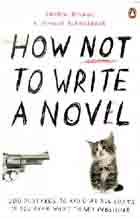
How Not To Write A Novel -

Ok, i have read numerous books on writing. I have stopped midway through many, my eyes and mind drained and befuddled from terminology and small print and i walk away with a terrible feeling of trepidation - that i will never be good enough to actually write a book (and remember all this nitty things that are so important - pov, climax, development etc.)
Wandering one day, i saw this little book, i picked it up, bought it and began to read it on the train home and i didn't stop till i was completely finished. It now sits by my bed (in a very honoured position) between my Stephen King 'on writing' and 'elements of style'.
In humorous, short anecdotes and tips, this book outlines all the things a person can do WRONG, and strangely enough its one of the most positive writing books i've read because its advice is sensible, practical and the examples portray clearly what they mean.
In 255 pages, and 200 mistakes Sandra Newman and Howard Mittelmark take you from Plot to how not to sell a novel, with lots of great information in between AND with lots of humour too!
So, when i was reading through and saw about ten things that i was doing wrong, i actually laughed, and nodded my head to myself - sniggering at my stupidity because through their amazing fun and friendly style, mistakes are shown and criticism is offered in a easy to swallow form (especially to the hyper sensitive newbie).
Definitely ten out of ten and light years ahead of many 'how to' books! This book is worth every cent!
For more information : http://www.hownottowriteanovel.com/
Monday, September 21, 2009
Interview: Will Lavender
1) First off, when did you decide you wanted to write, and how did you come to write this novel? Where did you get the idea for Obedience from?
2) The plot twists are great - how hard was it for you to keep some information hidden, and lead the characters where they are supposed to go? I'm guessing you must have had a very good plan. Were there times when you missed things, or did most of it come out right first time?
3) Can you tell us a bit about your next book? Is it in any way a sequel to Obedience?
4) I'm dying to know - what happens to Brian after the end of Obedience?
5) Did you ever have doubts about or trouble being published? How did you get your agent & publisher?
6) What advice would you give to aspiring writers?
Friday, September 18, 2009
When Writers Blog: an Interview With Jon Gibbs
WHEN WRITERS BLOG: An interview with Jon Gibbs by gapyeargirl123
On January 11, 2009, novel and short story writer, Jon Gibbs, made the debut post on his online journal. Aside from his long-suffering wife, Denise, only one other person read the entry.
Now, thanks to features like the regular Friday links to interesting posts by writers, agents and editors; oddball competitions like the Meager Puddle of Limelight Awards, and tongue-twisting acronyms like the one for IPAFPFYOJOJB (International Pimp a Favorite Post From Your Own Journal on Jon’s Blog) Day, An Englishman in New Jersey, receives over 1,000 visitors a month. Not bad for a virtually unpublished writer.
TBB: Wouldn’t a writer’s time be better spent working on stories and books rather than on a blog?
JON: It’s true that developing an online journal takes time and effort, but in my opinion, the benefits are well worth it. Aside from the fact that a blog can help you get your work seen by new readers, there’s a wealth of knowledge and writing know-how on the web. How much would you pay for helpful advice from successful authors, agents and editors in your genre? An online journal gives you access to people from all around the world. Many of them share their knowledge and experience on their blogs, for free.
TBB: When should a writer start blogging, and which service should they use?
JON: It’s never too soon to start. As for hosts, I use LiveJournal, but whichever provider you choose, you can keep in touch with people on other blog sites via things like RSS feed.
TBB: How often do you post entries?
JON: I try to post a minimum of four times a week.
TBB: Most entries on your blog are about writing. Where do you get your ideas?
JON: All writers have thoughts and experiences worth sharing, whether the theme is ‘Don’t make the same dopey mistake I did’ (like a lot of my own posts), or about how he/she approaches the craft. I also get ideas from my friends’ blogs. The inspiration for one of my most visited posts came from reading about someone else’s bad experience at a critique group.
TBB: What can someone do to get more people reading their blog?
JON: I’d say the most important thing is to write about what interests you. Different things work for different people, but if you have a passion for something, coming up with good posts on that subject shouldn’t be hard.
Invite discussion. Let’s say you’re a writer, blogging about your latest work-in-progress. Try adding “How about you?” at the end of the post. Those three little words make a world of difference to a blog entry. They show readers you want to talk to them, not at them.
TBB: What shouldn’t a blogger do?
Don’t be boring. Better no post at all, than a procession of uninteresting entries. That particularly applies to writers. If people find your journal dull, they may assume your writing is too.
Don’t ignore people. You’d think this was obvious, but a surprising number of bloggers seem to feel they don’t need to acknowledge those readers who take the time to post a comment on their journal. Maybe it’s just me, but for a writer, I think that’s the equivalent of saying, ‘Please don’t ever read a story or buy a book of mine.’
Don’t be afraid to post off-topic once in a while. My journal is mostly about writing, but I often throw in something on a different subject.
TBB: Which of your writerly blog posts are you most proud of?
JON: Hmm, I got a lot of good feedback for ‘The Critiquee’s Charter’ so let’s go with that.
TBB: What’s happening with your novels?
JON: I’m currently putting the finishing touches to my sci-fi thriller, Waking up Jack Thunder. My MG urban fantasy, Fur-Face, is under consideration with a publisher at the moment.
TBB: Most of your short stories are flash fiction (less than 1,000 words), is that deliberate?
JON: Yes. More and more people read (or listen to podcasts) on the web. With that in mind, it’s good for writers to have their stories available at the click of a button. I do submit to print markets, but for me, I’d rather sell my flash fiction to an online publisher.
TBB: Where can people find your writing on the web?
JON: I only have two 100-word stories online at present. They’re linked from my website, A Cat Of Nine Tales.
TBB: Final question: Where do you find time amongst all the things you have going on in your blog to actually write stories?
JON: I’m supposed to write stories too?
My old gran used to say, ‘You don’t find time, you make time’. Writers make time for pitch/query letters. They do that because they want people to read their work. A good blog will help you achieve that too. Rather than ‘Where do you find the time?’ a better question would be ‘Is it worth the time?’ to which my answer is a resounding ‘Yes!’
An active member of both The Garden State Horror Writers and The Monmouth Creative Writing Group, Jon Gibbs is the founder of the New Jersey Author’s Network. He can usually be found hunched over the laptop in his kitchen. One day he hopes to figure out how to switch it on. If you decide to visit his blog, tell him we sent you.
Tuesday, September 15, 2009
Interview: Jocelynn Drake
Nightwalker started a little differently than most of the other stories that I worked on. Nightwalker started as a writing experiment where I was playing with point of view. I wanted to tell a story about a vampire hunter through the eyes of his prey. Unfortunately, from the moment that Mira opened her mouth, she immediately dominated the story and it became harder to bring Danaus into the limelight.
When I started working on Nightwalker, it was nothing more than a short story and I never intended it to be more than that. However, a good friend read it and liked it so much that he demanded that I keep writing. So, I did. It took a lot of careful planning, but after getting about half of the book written I discovered that I had ideas for several other books that I was dying to tell about Mira and all the other characters in her world.
It wasn’t until I actually finished writing the first book that I considered trying to get it published. Prior to that, I was writing for myself and my friend. After finishing it, I went through several drafts of polishing it. After working on it for several months, I started sending out query letters to agents. I got a few good nibbles, but nothing definite. The most common comment was that they liked my voice, but the book just wasn’t there yet. One excellent agent complained that it was too long. I cut the book in half so that I now had what would become Nightwalker and Dayhunter already written before I even sold the series.
I remember that it had been two years of rejections and I was getting worried. It was the week before Mother’s Day and I sent out five electronic queries to agents. I swore that if I didn’t get a serious bite from this group, I was going to pack the book away and work on another project. By the following Monday, I had an agent, and she’s everything that I’ve been looking for in an agent. She’s amazing and she loves my work.
From there, we spent a week tweaking the book before she blasted it out to several publishers. Three weeks later, we had a contract offer from an amazing editor at Eos/HarperCollins. I was in heaven. It took me a while the land an agent, but getting a publisher was extremely quick.
2) Your vampires often seem quite a lot darker than in many other urban fantasy books at the moment. What led you to writing such a dark book, or was Mira's story always like that, since you first thought of her?
For me, I’ve always preferred my vampires to be dark, vicious creatures. I tend to look at the dark side of humanity when I am writing. I like to wonder what would happen if you gave a human awesome powers, strength, beauty, and immortality. Would they retain that moral fiber they had during their human years? Or would it be worn away with time? Would the power go to their heads and would they abuse it? We’ve seen that kind of abuse through the years and it’s not such a stretch to believe that vampires would react the same way.
Another thing that was key to me was that I didn’t want a bunch of sad vampires, complaining about their lot in life. “I never wanted this.” That was something my vampires would never say. Each creature had to make the conscious choice to become a nightwalker and they had to fight death for it. If the human didn’t truly want to become a vampire, he or she would just die during the process of rebirth. My vampires want to be vampires. They enjoy their powers and they enjoy the thrill of the hunt. They had strong instincts for survival, and the vampirism really taps into their more animalistic emotions and urges.
3) How has life changed for you since Nightwalker and Dayhunter were published?
I guess the biggest thing for me that has changed is writing on a deadline. Before, I wrote stories whenever I felt like it. Most never were finished. I would write until I got bored with it and then I would start something else. Now, I have a strict deadline of when I have to turn in my next book, so that means that I have to keep a regular writing schedule and I have to stick to it, even when I don’t feel like working.
The other thing is that writing used to be time for me to play and daydream. In many ways, it still is, but I am now more aware of the fact that it is also work. When I start working on a story, now I have to seriously consider whether this is something that I want to have published. If it’s not, I typically have to push it aside. My time is very limited and I have to stay focused on pieces that I think are publishable. I hope to one day get back to playing a little bit when I write.
OK, this is where the spoilery-for-book-2 questions start - you have been warned!
4) From the end of book two, it seems like we're going to be seeing a lot more of the coven now. You have some great info on your website about the formation of the coven, but I was wondering if there's anything else you could tell us about the members of the coven, maybe things that Mira knows that just won't be in the story, or a little of their history, or any stray tidbits?
Hmmm…. That’s a great question. I have to say that pretty much everything that Mira knows about the Coven has been presented in the books. The Coven takes a backseat to the story in Dawnbreaker and Pray for Dawn, but they have a larger presence in Wait for Dusk, which is the fifth book in the series.
The Coven is a dark place in my world. It is where the true violent nature of nightwalker society originates. The one thing that I’m hoping to take a deeper look at is the various alliances that exist on the Coven. By the end of Dayhunter, there is a definite shift in power that will only help to prolong Mira’s life, but the other vampires are not about to sit idly by and allow it to happen without some kind of challenge.
One character from the Coven that I haven’t had the chance to introduce is Our Liege. The true ruler of the nightwalker race has sat back and been content to watch everything that has been happening. I will admit that I’ve known this character since Nightwalker. I know his name, his appearance, his mannerisms. Unfortunately, there are too many powerful characters already in the story. I need to strike a balance and not throw too much at Mira all at once. So, I’ve put off introducing him. However. I do have plans for his appearance late in the series. Don’t worry. He’s coming and he is his own ball of trouble.
5) So, Mira is Tristan's 'owner' now. Can you tell us anything about why she was reluctant to do that to anyone before, or what it means for them now? What does it actually involve for her?
Mira has always been reluctant to be the “owner” or parental figure in a nightwalker family. Her own experiences with Sadira were extremely bleak. She lived with Sadira for several years as a human and then another hundred years with her as a nightwalker. Sadira was very controlling, monitoring all of Mira’s movements and actions. Mira is very independent creature with a mind of her own. She chafes under too much restriction, so she never wanted to be in a position where she would have to restrict the movements of another creature.
Mira and Tristan’s relationship is very relaxed. It is partially a mother-son relationship and partially a brother-sister relationship. He is both younger and weaker than Mira, so she feels the need to protect him at all time. And yet, because Sadira is their maker, she is his sister in a way. Because Mira is his “owner” she is responsible for his safety. Should he get into trouble, Mira could step in and protect him if she wanted. Of course, she could also leave it to him to take care of his mess himself.
Tristan is one of my favorite characters. His weakness is not a detriment as it might seem in their violent world. It means that he is more in tune with his emotions, with the frailty of humans, and the general frailty of the world. He had a softening effect on Mira, which she needs. When things get bleak, Mira tends to become very hard and distant. Tristan’s presence will help her retain her hold on her humanity a little while longer. On the other hand, Mira can teach Tristan to survive.
6) I don't see how anyone can read these books and not love Danaus - is there anything at all that you can tell us about him? Any teeny-tiny little bits of information?
I love Danaus too. He’s one of my favorite characters ever. I’ve had a lot of trouble getting into his mind because he doesn’t always like to talk. He’s strong, brave, honest, and reliable. He is also sarcastic, with a sharp, dry wit. I adore him.
Secret Danaus tidbits? Let’s see. Danaus was born just outside of Rome nearly two centuries ago. His mother was a witch and his father was a senator. To keep his family beyond the reach of Roman politics, he kept his wife and son outside of the city in a rambling estate. His wife didn’t like the arrangement, so she called on a demon to give her more power so she could seek her revenge on her husband. In exchange for the power, the demon claimed part of the soul of her unborn son.
Danaus didn’t discover the arrangement until he was in his early twenties. He had been mortally wounded in a battle not far from Rome. The medics looked at him and shook their heads, confident that he would die. But, by morning, he was up and walking around, almost completely healed. Everyone proclaimed that it was a miracle visited on him by the gods. Danaus was skeptical. That night, he rode to see his mother at the estate that he grew up at. She confessed that she had made a deal and that he had been blessed with amazing strength and healing powers. Danaus was enraged that his soul no longer belonged to him. In the blindness of his rage, he killed his mother by boiling her blood. Afterward, Danaus left the city of Rome and has never set foot in the city again.
7) Last one! Can you tell us a bit about Dawnbreaker, in your own words? What do we have to look forward to when that comes out at the end of the month?
Dawnbreaker takes place a couple months after the conclusion of Dayhunter in Savannah where Mira is being hunted by the naturi. They are desperate to capture and destroy the vampire, as she and Danaus are the only ones that could potentially stop the naturi from freeing Aurora, Queen of the naturi, and the rest of the naturi people. While fighting the naturi, Mira is lucky enough to take a hostage that could help her turn the tables on the naturi when she and Danaus finally go to the final showdown at Machu Picchu, Peru. The dawn lies just over the horizon and Rowe is desperate to finally free his wife-queen. The time has come to face the past.